Since nothing has changed in centuries, certainly mayors and governors have blood on their hands. Either they have acquiesced in police murders and lynchings or else they are powerless or too frightened to prevent them-- they only pretend to govern the police.
The lesson is further driven home when the police are not unleashed by governors and mayors upon the gun-toting, venom-spewing, right-wing rabble recently invading state and city seats of government.
How is this failure explained?
Under capitalism, the police, like the military and the security services, are direct agents of the ruling class, unmediated by popular control. All three, in their areas of responsibility, are the “legitimate” purveyors of violence and aim to own a monopoly on violence. As much as governments aspire to maintain and promote an image of consent, the three institutions are the coercive backstop to threats to elite rule. As governors and mayors come and go, they remain as watchdogs to unrest, messengers of the folly of resistance.
Historically, the nationally oppressed African American people have offered the greatest collective resistance to the US ruling class. Their former enslavement, their very limited enjoyment of basic bourgeois democratic norms, and their continued physical and economic segregation has given them every reason to struggle against, often leading in the struggle against, the injustices of the capitalist system. That tradition has placed African Americans in the cross-hairs of wealth and power and their trusted security apparatuses. It is, therefore, no surprise that the police wield their repressive powers so violently against Black people.
The lesson is further driven home when the police are not unleashed by governors and mayors upon the gun-toting, venom-spewing, right-wing rabble recently invading state and city seats of government.
How is this failure explained?
Under capitalism, the police, like the military and the security services, are direct agents of the ruling class, unmediated by popular control. All three, in their areas of responsibility, are the “legitimate” purveyors of violence and aim to own a monopoly on violence. As much as governments aspire to maintain and promote an image of consent, the three institutions are the coercive backstop to threats to elite rule. As governors and mayors come and go, they remain as watchdogs to unrest, messengers of the folly of resistance.
Historically, the nationally oppressed African American people have offered the greatest collective resistance to the US ruling class. Their former enslavement, their very limited enjoyment of basic bourgeois democratic norms, and their continued physical and economic segregation has given them every reason to struggle against, often leading in the struggle against, the injustices of the capitalist system. That tradition has placed African Americans in the cross-hairs of wealth and power and their trusted security apparatuses. It is, therefore, no surprise that the police wield their repressive powers so violently against Black people.
Of course that perspective-- the class-based understanding of racism-- never gets a hearing in the monopoly media. Instead, police murders are attributed to “bad apples,” poor training, misleadership, lack of Black police, lack of oversight, and the catch-all of “racism,” as though racism can be explained by simply invoking the charge of “racism.”
Yet all the well-intentioned reforms-- training, civilian review boards, screening, etc.-- have failed to stop police violence against Blacks.
Liberals are fond of studying police violence, especially when the reaction to police misconduct brings masses of people into action. The classic example of liberal response to Black rebellion was the 1968 Kerner Commission. While the Commission’s findings were among the first (and probably last) candid, official exposures of the economic base of Black disadvantage, little or nothing was done to rectify that disadvantage. The promising affirmative action programs offered at the time were effectively killed by 1976, disappearing from the Democratic Party program.
When the US ruling class refuses to address the plight of the disadvantaged majority of Blacks, the police also get the message of official neglect, of contempt. Blacks die from poverty, bad health care, inadequate infrastructure and poor services, pandemics, and, of course, police violence. The message sent by the police is: don’t resist wealth and power.
Sadly, most mainstream commentators opportunistically force the discussion of police violence into the two-party box, to frame it in the context of the forthcoming elections. Trump’s response to the murders of George Floyd, Breonna Taylor, and Ahmaud Arbery is as crudely racist as his earlier full page New York Times ads condemning the five Black youths falsely convicted as the Central Park Five. One senses the same fear and hatred of Blacks as that of an unreconstructed, Southern segregationist like Orville Faubus or Strom Thurmond.
Biden, on the other hand, mouths the liberal platitudes that have been typical of Democratic Party politicians since Otto Kerner’s famous report: a robust denouncement, a call for change, and inaction. His supporters are either ignorant of or willfully ignoring his own role in fanning racist violence: attacking busing, supporting the militarization of the police, boosting mass incarceration.
One candidate represents the moonlight-and-magnolia racism of the segregated South and the other the more sophisticated Northern racism of malign “benign neglect.” Both are irrelevant to stemming police violence.
To see the ineffectiveness of corporate Democrats, one need only be reminded of Barack Obama’s response to police violence when a racist cop accosted a Black Ivy League academic on his own porch: have a beer with both of them.
Or, as Cornel West passionately insisted in a CNN interview: "We've tried black faces in high places... Too often our black politicians, professional class, middle class become too accommodated to the capitalist economy, too accommodated to a militarized nation-state, too accommodated to the market-driven culture of celebrities, status, power, fame, all that superficial stuff that means so much to so many fellow citizens."
West went on to describe the inadequate response of the Democratic Party to police violence: "You've got a neoliberal wing of the Democratic Party that is now in the driver's seat... because all they want to do is show more Black faces—show more Black faces. But oftentimes those Black faces are losing legitimacy, too—because the Black Lives Matter movement emerged under a Black president, a Black attorney general, and a Black director of Homeland Security, and they couldn't deliver. So when you talk about the masses of Black people—the precious poor and working-class black people, brown, red, yellow, whatever color—they're the ones left out and they feel so thoroughly powerless, helpless, hopeless—then you get rebellion."
On The Hill.TV’s Rising, Nina Turner, a national co-chair of the Sanders campaign, astutely endorsed West’s comments as “poignant, right on time, as usual, an indictment of both the Republican Party and the Democratic Party.”
“Dr. West is making people very uncomfortable, especially the Democrats, and they should be uncomfortable... For me right now, this is not about your political affiliation, this is about right or wrong. Whether you have the commitment, the character, the clarity, the vision and the leadership to sacrifice something and to do the right thing on behalf of Black people in the United States of America.”
Leave it to Susan Rice, Obama confidant and former National Security Advisor, to take the ruling-class spin on the uprisings to laughable, ludicrous levels. In a CNN interview with the readily agreeable Wolf Blitzer, she finds Russia lurking behind the scenes to promote violence in the nationwide protests.
Alarmed by the unfettered power accumulated by the military and its affiliates, President Eisenhower, himself a participant at the highest levels, warned of the attendant dangers:
Similarly, the “misplaced power” of the police threatens the lives and well-being of African Americans, the poor, and working people. Like the military and the security agencies, the role of the police cannot be separated from its central function of protecting wealth and privilege. It cannot be detached from the capitalist system.
The insurrections that are rising throughout the US are a remarkable sign of both the breadth and depth of anti-racist sentiment. They are inclusive in the best possible way. And they have frightened the Trumps, Cuomos, DeBlasios and the others charged with maintaining compliance with the system. The capitalist media is doing its best to shatter the hard-won unity against racism and against the police.
Insofar as the police are central to maintaining the legitimacy of capital, the rebellion is a rebellion against capitalism, whether its participants recognize it or not.
We must do everything to safeguard that unity and expose the source of racism and police violence: capitalism.
Yet all the well-intentioned reforms-- training, civilian review boards, screening, etc.-- have failed to stop police violence against Blacks.
Liberals are fond of studying police violence, especially when the reaction to police misconduct brings masses of people into action. The classic example of liberal response to Black rebellion was the 1968 Kerner Commission. While the Commission’s findings were among the first (and probably last) candid, official exposures of the economic base of Black disadvantage, little or nothing was done to rectify that disadvantage. The promising affirmative action programs offered at the time were effectively killed by 1976, disappearing from the Democratic Party program.
When the US ruling class refuses to address the plight of the disadvantaged majority of Blacks, the police also get the message of official neglect, of contempt. Blacks die from poverty, bad health care, inadequate infrastructure and poor services, pandemics, and, of course, police violence. The message sent by the police is: don’t resist wealth and power.
Sadly, most mainstream commentators opportunistically force the discussion of police violence into the two-party box, to frame it in the context of the forthcoming elections. Trump’s response to the murders of George Floyd, Breonna Taylor, and Ahmaud Arbery is as crudely racist as his earlier full page New York Times ads condemning the five Black youths falsely convicted as the Central Park Five. One senses the same fear and hatred of Blacks as that of an unreconstructed, Southern segregationist like Orville Faubus or Strom Thurmond.
Biden, on the other hand, mouths the liberal platitudes that have been typical of Democratic Party politicians since Otto Kerner’s famous report: a robust denouncement, a call for change, and inaction. His supporters are either ignorant of or willfully ignoring his own role in fanning racist violence: attacking busing, supporting the militarization of the police, boosting mass incarceration.
One candidate represents the moonlight-and-magnolia racism of the segregated South and the other the more sophisticated Northern racism of malign “benign neglect.” Both are irrelevant to stemming police violence.
To see the ineffectiveness of corporate Democrats, one need only be reminded of Barack Obama’s response to police violence when a racist cop accosted a Black Ivy League academic on his own porch: have a beer with both of them.
Or, as Cornel West passionately insisted in a CNN interview: "We've tried black faces in high places... Too often our black politicians, professional class, middle class become too accommodated to the capitalist economy, too accommodated to a militarized nation-state, too accommodated to the market-driven culture of celebrities, status, power, fame, all that superficial stuff that means so much to so many fellow citizens."
West went on to describe the inadequate response of the Democratic Party to police violence: "You've got a neoliberal wing of the Democratic Party that is now in the driver's seat... because all they want to do is show more Black faces—show more Black faces. But oftentimes those Black faces are losing legitimacy, too—because the Black Lives Matter movement emerged under a Black president, a Black attorney general, and a Black director of Homeland Security, and they couldn't deliver. So when you talk about the masses of Black people—the precious poor and working-class black people, brown, red, yellow, whatever color—they're the ones left out and they feel so thoroughly powerless, helpless, hopeless—then you get rebellion."
On The Hill.TV’s Rising, Nina Turner, a national co-chair of the Sanders campaign, astutely endorsed West’s comments as “poignant, right on time, as usual, an indictment of both the Republican Party and the Democratic Party.”
“Dr. West is making people very uncomfortable, especially the Democrats, and they should be uncomfortable... For me right now, this is not about your political affiliation, this is about right or wrong. Whether you have the commitment, the character, the clarity, the vision and the leadership to sacrifice something and to do the right thing on behalf of Black people in the United States of America.”
Leave it to Susan Rice, Obama confidant and former National Security Advisor, to take the ruling-class spin on the uprisings to laughable, ludicrous levels. In a CNN interview with the readily agreeable Wolf Blitzer, she finds Russia lurking behind the scenes to promote violence in the nationwide protests.
Alarmed by the unfettered power accumulated by the military and its affiliates, President Eisenhower, himself a participant at the highest levels, warned of the attendant dangers:
In the councils of government, we must guard against the acquisition of unwarranted influence, whether sought or unsought, by the military–industrial complex. The potential for the disastrous rise of misplaced power exists, and will persist.
Similarly, the “misplaced power” of the police threatens the lives and well-being of African Americans, the poor, and working people. Like the military and the security agencies, the role of the police cannot be separated from its central function of protecting wealth and privilege. It cannot be detached from the capitalist system.
The insurrections that are rising throughout the US are a remarkable sign of both the breadth and depth of anti-racist sentiment. They are inclusive in the best possible way. And they have frightened the Trumps, Cuomos, DeBlasios and the others charged with maintaining compliance with the system. The capitalist media is doing its best to shatter the hard-won unity against racism and against the police.
Insofar as the police are central to maintaining the legitimacy of capital, the rebellion is a rebellion against capitalism, whether its participants recognize it or not.
We must do everything to safeguard that unity and expose the source of racism and police violence: capitalism.
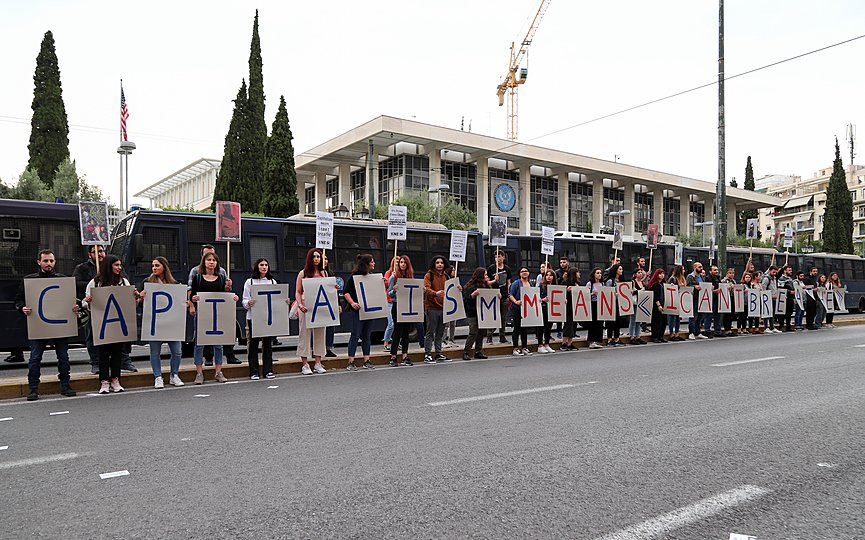
Greek Communist youth protesting racist US police murder outside the US embassy
Greg Godels
zzsblogml@gmail.com

