Search This Blog

Showing posts with label Chile. Show all posts

Tuesday, September 28, 2021

Occupy in the Rearview Mirror

Ten years ago, September 17, 2011, protesters settled in Zuccotti Park in the New York City financial district, a privately held park owned by Brookfield Office Properties and named after its former chairman. This action acquired the simple, straightforward, but somewhat misleading moniker, “Occupy Wall Street.”


While the specific motivations of the congregation are debated, there is a general agreement that the 2007-2009 economic crisis, and especially the failure to punish its perpetrators, was an instigation. Occupy became a phenomenon, even a brand in the era of memes, social media, and ultra-consumerism. Occupy-like copycats sprang up around the country and in different forms of activism. 


In its initial form, Occupy was an open invitation to gather in a public or semi-public space and hold it. The participants resisted a program, organizational structure, or leadership. Like previous efforts at anarchist levelling-- so-called “radical” or “participatory democracy” -- everyone was nominally of equal voice and stature. And like its anti-structure antecedents in the New Left, the Zapatistas, the anti-Globalization movement, the Indignados, etc., one can only wonder how its spokespeople, organizers, “facilitators,” or anti-leaders, are democratically selected in the absence of some structure. 


The common thread that runs through all of the celebrated anti-hierarchical organizations is a semi-religious confidence in spontaneity. All worship at the altar of this elusive idea, despite the fact that there is no successful historical precedent to support faith in its success. 


Though the Occupy movement succumbed after two months to a brutal assault by the coercive forces of the US ruling class, it left a popular slogan that continues to be embraced by a large sector of the US left: “We are the 99 percent!”

The Ten-Year Retrospective

Not surprisingly, various estimations of the value of Occupy are springing up on the 10th anniversary of the initial occupation. They range from the romantically naive, crediting Occupy with spurring every struggle since 2011, including the minimum wage fight and the teacher strike wave of 2018, to the coldly skeptical viewing of Occupy as an opportunity lost to “performative acts” or merely an historical “blip.” 


Michael Levitin, writing in The Atlantic contends that Occupy “made protesting cool again… it brought the action back into activism…” In fact, protesting has never been “cool;” it requires a sacrifice on the part of participants. More importantly, it should conjure a commitment beyond an event, a performance, a statement. Protesting requires the uncool tedium of building a movement that can grow sufficiently to tackle the unequal power of the rulers, a goal difficult to achieve without leadership, organization, and structure. The “1%” is more than the economically privileged; the “1%” has also accumulated massive power largely immune to the incantations of a general assembly. 


Micah L Sifrey, writing in The New Republic, references a somewhat chastened Occupy Wall Street organizer, Jonathan Smucker from his book:

Occupy wasn’t just a success in putting class back on the American agenda.

It was also “a high-momentum mess that ultimately proved incapable of mobilizing beyond a low plateau of usual suspects.” As he wrote in his book Hegemony How-To, “We were not merely lacking in our ability to lead the promising social justice alignment that our audacious occupation kicked off; many of the loudest voices were openly hostile toward the very existence of leadership, along with organization, resources, engagement with the mainstream media, forging broad alliances, and many other necessary operations that reek of the scent of political power.” Because Occupy’s general assemblies were so time-consuming and so easily hijacked, much of the real work and decision-making went elsewhere, “into underground centers of informal power,” he writes. 


It’s possible to look at Occupy as an experiment for its time-- 2011 was the year of the rise of Spain’s anti-austerity movement, the Indignados. Occupy came shortly after the Tunisian Jasmine Revolution which sparked the Arab Spring. All shared the elements of non-violence (by protesters), spontaneous or near-spontaneous risings, absence of a clear program, an allergy to hierarchies, and cross-class engagement. None were led by traditional leftist parties or ideologies (apart from a nebulous connection with anarchism). And-- a conclusion that none of the commentators want to accede-- all faded away, leaving the balance of power essentially unchanged.


Occupy did demonstrate the power of social media and internet communication. Old-timers were in awe at the ease and speed that people could be rallied around actions and events. Time proved that the new technologies came with a downside: action came almost too easily and with minimal commitment or understanding. Activism often sprang from the same emotional immediacy as going to a concert or movie. One commentator called Occupy “exhilarating” -- a kind of political Woodstock?


Arun Gupta, writing in In These Times, casually notes: “Every movement reaches the end of the road, and a decade later Occupy-style protest has smacked into a dead end.” 


Yes, Occupy-style protest is exhausted today, but Gupta’s dismissing that demise with a shrug reflects a measure of political immaturity. Any movement bent upon challenging inequality, injustice, capital, or, most importantly, capitalism, cannot accept a dead end as an inevitability. Quite the opposite, any movement promising success must stay the course if it holds out any hope of winning against an unprecedented accumulation of power in so few hands and a long history of falling short. Occupy lacked that vision.


Gupta writes of the “authenticity” of Occupy and the satisfaction drawn by its participants. Insofar as it served as a “pre-school” for a generation of young people deeply scarred by student loans, poor job prospects or unemployment, and deeply disappointed with the political establishment, Occupy was a worthy introduction. Insofar as political elders, movement veterans, and theorists accept Occupy as the road forward and offer no alternate routes, they bear much of the responsibility for the collapse of the movement.

The Lessons

Clearly, many feel strongly that the legacy of Occupy is worth fighting over. Witness the statement by the Metropolitan Anarchist Coordinating Council, claiming Occupy as its own. Or the debate in The Nation: Was Occupy Wall Street More Anarchist or Socialist? 


Undoubtedly, Occupy served to introduce thousands of young people to collective action, to resistance to the rich and powerful. With “the 99 percent” slogan, many saw social life in the US through a rudimentary lens of class division for the first time, a reality denied us by our education system, our media, and our leaders.


But “the ninety-nine percent versus the one percent” construction was far too simplistic and far too crude to capture the differences or reflect the structure of twenty-first century capitalism. It failed to explain the divisions that kept the ninety-nine percent or its various strata and classes from uniting against the one percent. It failed to fit this simplification into the dynamics of the two-party system-- a system of control fundamentally owned by the one-percent and its allied strata-- while denying effective power to everyone else. It failed to offer a road map either inside or outside of that decadent structure. 


In short, “the ninety-nine percent” was analytically far too blunt of an instrument to advance Occupy beyond well-intended street theater. 


What was needed was a deeper class analysis that more accurately distinguished between the exploited and the exploiters. If they would have bothered to look, Occupiers might have found that more profound analysis in Marxism-Leninism.


Occupy follows a long trajectory of “new” radicalism in the US shaped by subtle, but long-festering anti-Communism. Since the purging of Communists and their allies from US social and political life in the post-war era, every version of revitalized resistance pays subtle, but uncompromising homage to the religion of anti-Communism-- a silent loyalty oath. From the student-based New Left to Occupy, it was understood that the limits of tolerance ended at the door to authentic Marxism-Leninism.


Instead, every emerging movement ostentatiously showcased its commitment to “democracy” in stark contrast to the caricature of Communism and its alleged soulless hostility to the individual. The cult of the individual and a utopian “participatory” democracy is meant to demonstrate a breed of radicalism distinctly different from the Cold War image of Communism. Thus was born a kind of individualistic, petty-bourgeois anarchism characteristic of US activists from early SDS to Chomsky and to Occupy.


Where anathema to the lessons of over a hundred and fifty years of Communist and socialist (and anarchist, as well) practice were not purposely obscured, different outcomes ensued. The Chilean student movement, though concurrent with the Occupy phenomenon, is a case in point. Though virtually ignored by the media and the US left, Chilean high school and university students demonstrated from 2011 until 2013 for educational reform. 


Unlike Occupy, the protests were highly organized, welcomed democratically chosen leadership, and constructed a coherent set of demands. In addition, the students engaged and were joined by the Chilean labor movement. The left political parties collaborated and enjoyed growth from their engagement, particularly the Chilean Communist Party. The successful socialist candidate for president in 2013, Michelle Bachelet placed educational reform at the top of her agenda.


Students again sparked the August 2019 protests that continued through the next two years, with over a million Chileans in the streets on October 25, 2019 in Santiago alone.


Unlike Occupy, the Chilean student protests of 2011 led directly to the empowerment of the left, electoral gains, and a referendum opening the way to a new constitution.


The political maturity of the Chilean movement and its successes serve as a stark counterpoint to the shortcomings of the Occupy model of resistance.


To its credit, Occupy broke the pattern of movement quiescence during a Democratic Party administration. For decades, anti-war and reformist protests only took on a mass character when the Republicans were in power. The anti-war demonstrations of the Bush administration were never duplicated, not even when Obama engineered the troop surge in Afghanistan. The dominant liberal and social democratic wings of the left fear antagonizing the Democratic Party torchbearers, unleashing street heat only when Republicans are in power. Allergic to electoral politics, the anarchists at the core of Occupy fearlessly and determinedly pressed forward during the Obama years.


Nonetheless, after two months of intense media attention, exhilarating public theater, and sincerely felt protest, the Occupy movement was swept away by military-like operations of the police. With no deep moorings, no road map, and no lieutenants or captains, the movement was shattered into many pieces. Some, in frustration, sought to change the Democratic Party; some sold their souls to the social-change-industry of NGOs, foundation grants, and non-profit social engineering; some returned to academia; and some, out of cynicism, simply dropped away.


An unlikely chronicler, loyal Democrat Robert Reich, noted perceptively that a contemporary right-wing populist movement, the Tea Party, expressing outrage against the powers-that-be from a different perspective, found much more success in shaping the political terrain. With its focus on performance over program, form over content, spontaneity over organization, Reich could understandably not see any hope that Occupy would change the course of history.


Well before Reich’s skepticism, V.I. Lenin railed against spontaneity in his classic polemic against the enemies of organized leadership, in What Is to Be Done? Lenin mocked actions that came to be called “participatory democracy” as examples of “toy” or “primitive” democracy. While they appear to be ultra-democratic, they actually inhibit serving the cause of the people with their endless obsession over procedure. 


Occupy ran aground on the shoals of procedural sectarianism, organizational chaos, and the lack of a programmatic compass. Will the lessons be heeded or will the US left continue to flirt with “toy” democracy over substance, cultural expression over political engagement?


Greg Godels

zzsblogml@gmail.com


Thursday, May 27, 2021

Chile, after nearly fifty years of despair

On May 15 and 16 of this year, the people of Chile began a process to overturn the nearly 50-year interruption of the nation’s social and economic development. With the election of a representative body to a forthcoming Constitutional Convention, Chilean voters may finally break away completely from the nightmare imposed by the military-fascist regime of Augusto Pinochet.


The Chilean military’s coup in 1973 broke what was then the longest streak of formal parliamentary rule in any South American country. The international left viewed the Popular Unity coalition government, led by the Socialist and Communist Parties and elected in 1970, as an experiment testing the viability of the parliamentary road to socialism. The Chilean ruling class and the US government also saw it the same way and were determined to crush it.


With the socialist experiment destroyed by the coup and fascist rule installed, Chile became a laboratory for the most aggressive policies of market fundamentalism: privatization, deregulation, and the absolute administration of economic life by profitability. Under the direction of the so-called Chicago School of political economy, Chile became the dream of die-hard free-marketeers: a veritable Hobbesian state-of-nature.


The experiment failed, by bourgeois measures and even more so as measured by every misery index of the people's well-being.


Tragically, the debt incurred in unwinding the worst aspects of the disastrous policy exceeded the debt incurred by the Allende government in expanding the social benefits of the people in 1970-1973.


Since Pinochet’s departure, Chile has been in a limbo between the restraints on change imposed by the undemocratic 1980 Pinochet Constitution and the pressure for democracy and social advance pressed by the social movements.


Finally, with the May 15-16 election of a Constitutional Assembly, and the opportunity to construct a new, progressive Constitution and move beyond the 48 years of retarded development and backwardness, the future of Chile appears brighter. Especially significant in this election was the strong showing by the coalition led by the Chilean Communist Party, garnering the second-most delegates to the convention.


While this is a step forward, one must never forget the costs to the Chilean people of nearly half a century of the effects of fascist repression and unfettered economic exploitation. 


And one must never forget the ugly, brutal role of the US government in destroying the Popular Unity experiment, a role that the US continues to play in undermining independent developments in Venezuela, Cuba, Bolivia, Ecuador, Brazil, and virtually every other country in the Americas. 


Recently, a reminder of the sweeping, decisive, and unconscionable intervention of the US government and US institutions in Chile came from the records of a partisan of Chilean democracy, a first-hand observer and victim of the machinations of the shameful servants of US imperialism. 


Geoffrey Fox joined eleven other Chicagoans, including trade unionists Abe Feinglass, Ernie DeMaio, and Frank Teruggi, Sr (his son, Frank Jr was murdered by the Pinochet junta) on a fact-finding visit to Chile in February of 1974.  


Cramming interviews, meetings, and even clandestine contacts, the group experienced the full horror of the Pinochet butchery. As one military officer told them: “We have moved from the stage of mass slaughter to the stage of selective slaughter.” 


Upon his return, Fox penned a detailed, first-hand report of the findings. A vice-president of his own American Federation of Teachers (AFT) local, he naturally thought that the national union’s publication, The American Teacher, would be a ready recipient for an article chronicling the harsh fate of teachers under Pinochet.


And indeed, he was right. The editor, a long-standing defender of labor rights, David Elsila, gladly received Fox’s article and pressed for its publication. The article was typeset and all but printed.


But Fox and Elsila underestimated the reach of the Cold War anti-Communist consensus, from its core in the upper reaches of government through the security establishment, the educational system, the media, and the labor union leadership. The Cold War chill brought all of these institutions into compliance with US foreign policy goals (imperialist designs!). 


After purging the left from trade union work and expelling the left-led unions, the center-right labor leadership agreed to an unholy alliance with the US ruling class. In exchange for slavishly following, even promoting, US foreign policy, the labor chiefs sought to achieve an era of cooperation between capital and labor. It was a small price to pay for capital to grant nominal increases in wages and benefits, while getting labor subservience in quelling labor insurgencies in other regions of the world. Militancy and solidarity were surrendered for labor peace, a result satisfactory to both complacent labor leaders and the guardians of capitalism, but a shameful betrayal of the international working class.


No one personified this betrayal more than the assistant to the president of the AFT, Alfred Max Loewenthal. Nearly every AFL-CIO union and the Federation maintained gatekeepers to deny even a hint of radical ideology or militant action to appear within its bounds. More often than not, they were ex-Communists or Trotskyists, who bore extraordinary grudges against the Communist Parties and their left associates. They could be relied upon to vigilantly veto even a whisper of criticism of US imperial policy.


Most notorious of those was Jay Lovestone, an ex-Communist who parlayed his anti-Communism into the leading foreign policy advisor to the center-right in the labor movement and who constituted its conduit to the CIA. It is no exaggeration to view him as the leading Cold War organizer of the US labor movement’s role in its complicity with the CIA in resisting leftist labor movements throughout the world.


The AFT had its own gatekeeper in Al Loewenthal. He came into the labor movement as the leader of an anti-Communist local in the militant United Electrical Workers Union (UE). When a rival, anti-Communist union (IUE) was established to raid UE in the Cold War, Loewenthal enthusiastically joined, rising in the IUE hierarchy before escaping scandal and moving to AFT. 


Loewenthal became an important part of the AFL-CIO anti-Communist, pro-imperialist architecture, serving the notorious CIA collaborating AIFLD.


When Elsila dared to print Fox’s report in the AFT paper, Loewenthal was on it like the rabid watchdog that he was. 


In denying publication to the Fox report on the ruthless repression in Chile, Loewenthal explained:

In essence, what I have written is a criticism-- perhaps also a protest--using the Fox article as a glaring example of the injection of an ideology into A.T. [The American Teacher] which is at variance with AFT and AFL-CIO policy on a current matter.... Even worse, its publication would have made the A.T. the dupe of a Communist strategy on Chile and opened AFT to ridicule.


Elsila mounted an admirable defense, though to no avail. Anti-Communist hysteria always won out in the eviscerated, post-war, Cold War labor movement, as it often does today. He wrote in his appeal:

Fox is a reputable sociologist who has written studies on Latin America; he speaks Spanish fluently; and his trade union credentials include having been elected vice president by his AFT local. The goal of the committee was to determine to what extent workers are suffering under the junta and to report its findings. The commission’s report and Fox’s article are based on interviews with the US ambassador to Chile, junta officials, trade unionists, rank-and-file workers, and others. It is about as comprehensive a report on the status of things today in Chile as one can get.


Of course, none of that mattered to staunch Cold Warriors. Thus, the AFT joined, unknown to its members, in propping up a fascist dictatorship and in taking a stand on the wrong side of the history of the workers’ movement. The members could not be trusted to make up their own minds on the butchery in Chile. 


In place of a report urging solidarity with workers in another land, AFT members got another Cold War saga about Alexandr Solzhenitsyn, a Soviet dissident. Years later, after Solzhenitsyn was no longer useful to the security services, we learned of his ultra-conservatism, his disdain for democracy, and his anti-Semitism. Truth was sacrificed in the interest of US imperial objectives.


Fox and Elsila fought the good fight. Elsila soon left AFT to edit Solidarity, the newspaper of the United Auto Workers (UAW), a union with its own unpleasant Cold War legacy, but a touch more tolerance. Fox continued teaching and writing about Latin America and addressing other progressive themes: his novel on the Paris Commune will be out later this year.


Their story is more than an anecdote about the Cold War. It is not a reminder of the past; rather, it exposes the unseen mechanisms that constantly mesh and turn, burnishing a false depiction of US foreign policy while undermining the bonds of our common humanity. The same institutions that surrendered their independence, sold their integrity for acceptance in ruling circles, and stained international solidarity operate today in enabling US rulers to undermine social progress from Venezuela to Afghanistan and many places in-between and beyond. 


The dishonesty and ideological corruption that drove Loewenthal to serve the forces destroying Chile after 1973 are still infecting the media, the NGOs, the CIA-funded front organizations, the public intellectuals, the security services, the foreign affairs establishment, and, sadly, the labor movement.


The cost to Chile has been incalculable.


Now, maybe, the Chilean people can move forward again.


Greg Godels

zzsblogml@gmail.com


Wednesday, February 6, 2019

Solidarity with the People of Venezuela!

This coming September will mark 45 years since the US helped engineer a bloody coup against the Chilean government, a government seeking to break the chains of imperial dominance and capitalist enslavement. Today the US government is at it again, engaging its enormous power to destroy a liberating project of the Venezuelan people. In the interim, US dirty hands have been present in thwarting the self-determination of peoples throughout the world, in some cases multiple times. Afghanistan, El Salvador, Nicaragua, tiny Grenada, Panama-- the list of the violated goes on and on-- extending to more recently, Libya, Syria, Ukraine, Honduras, and, at the moment, Venezuela.

It doesn’t matter whether the US is ruled by Republicans or Democrats. When the first whiff of national independence is detected by the global watch dogs, the alarm sounds and the political “leaders” fall in line.

Surely only the willfully blind fail to see a pattern. You don’t have to be a Marxist to grasp that the US is systematically and unilaterally reining in countries deemed by its corporate interests to be renegades. Nor do you have to study Lenin to see that this is the behavior that history associates with empires. Thus, the word “imperialism” should come easily to even those who have little or no knowledge of the scientific precision of the term.

And it is US imperialism that now holds Venezuela in a death grip.

Unlike with Chile, the facts are readily before us. In the midst of the Cold War, the US went to great lengths to disguise its intervention behind the cloak of the covert services. In the intense competition with the socialist countries, the US fought hard to appear on the world stage as a champion of democracy. US aggression hid behind the doctrine of “plausible deniability.”

But today, in the attempted subversion of Venezuelan self-determination, there are no masks, no cloaks, no double talk. The plan is out in the open. We can find public records of the millions of dollars allocated for phony human rights groups, for subversive NGOs, for opposition parties, and even for purveyors of violence. We can trace the escalation of sanctions through three administrations, sanctions designed to disrupt, cripple, and dismantle Venezuela’s economy and finances. Ironically, the Venezuelan people's US CITGO operation once offered free home heating oil to the US needy. Today, the US government is attempting to steal CITGO from the Venezuelan people.

Oppositional electoral tactics, assassination attempts, and street violence failed to provoke the Venezuelan people into rejecting the Bolivarian process. The failures, the corruption, the leadership strife, and the foreign dependency of the opposition instead led directly to the sweeping electoral victory by President Maduro in the 2018 election.

In response to the divided and demoralized opposition, the US government rallied Maduro’s enemies behind a naked plan-- a plan both desperate and extremely audacious-- to depose the legitimate government with a virtual unknown, notable for his penchant for extremism and his malleability before his US masters. Urged on by notorious gusanos-- Republican Senator Marco Rubio and Democratic Senator Robert Menendez-- US operatives met with the opposition in late December/early January, according to The Wall Street Journal, and began to concretely develop the plans for a coup based upon a parallel government. An administration official reported to the WSJ that “The opposition at this point believed, and told US officials, that they needed the international community’s backing to affect the political dynamic inside Venezuela.”

The plan went forward and weeks later Vice President Pence called the dutiful puppet and told him to proceed. The next day, the young graduate of George Washington University, Juan Guaidó, stood with a gaggle of his supporters and announced that he was, in fact, the President of Venezuela. This must have come as a shock to most Venezuelans who did not recall his name on the previous May’s Presidential ballot. Yet like abject toadies, government ministers in Latin America, Canada, and the EU immediately made anti-Maduro noises, called for new elections, or even threatened to recognize the unelected President. That is the reality of Jack-in-the-Box imperialism.

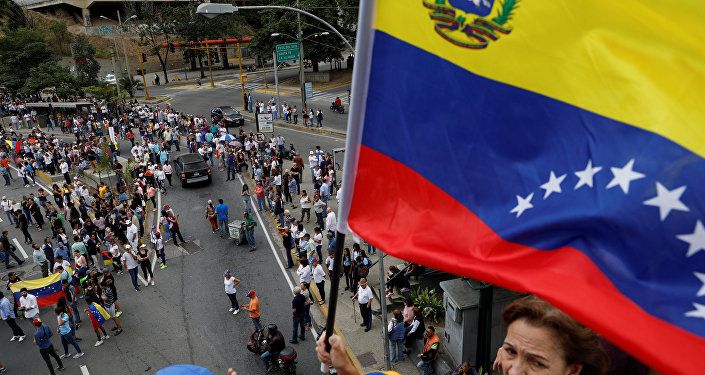
The US media, willing collaborators with the coup plotters, have for years deemed Maduro a dictator, a tyrant, a murderer, and worse. They eagerly returned to those themes with horror stories and accounts of deprivation and economic duress without a mention of the draconian sanctions that bleed the Venezuelan economy. After the call for January 30 demonstrations, NPR, a particularly vicious journalistic beast (“Stop the Maduro Genocide”), reported “Protesters filled streets across Venezuela on Wednesday in a show of strength for Juan Guaidó….” Accompanying the article is a picture of a handful of demonstrators, reminiscent of the infamous toppling of the Saddam statue in Baghdad.

The Wall Street Journal similarly recorded the Wednesday demonstrations (see below) with the apologetic caption: “Venezuelans opposed to Nicolas Maduro protested in Caracas on Wednesday. Larger antigovernment protests are expected Saturday.”


Quite a “show of strength”!

Similarly, Sunday morning’s CBS News website coverage of the opposition’s Saturday demonstration carried an impressive picture of a massive march. But curiously, the marchers constituted a sea of red, the colors worn by the Chavistas. By Sunday evening, the picture was gone.

The videos of the well-to-do marchers and the pot-bangers will bring back to many of us memories of the strident, orchestrated Chilean momias who served imperialism well with overwrought drama prior to the 1973 coup.

Showing their customary spinelessness, Democrats ignored, equivocated, or hailed the coup attempt. Illinois Senator Durbin was absolutely ecstatic. The so-called progressive wing was little better. Only Tulsi Gabbard courageously and emphatically spoke against the coup, despite the fact that her Presidential campaign has come in for brutal, unprincipled attack by the media. For a sampling of shameful vulgarity by most politicians, watch Max Blumenthal’s interviews of legislators commenting on the coup attempt.

This is the moment that requires unwavering, unqualified solidarity with the Venezuelan people and their elected government. If human rights mean anything, they must be universal; they must extend to everyone regardless of whether we share their beliefs or their politics. And at the top of the rights hierarchy, as its exponents agree, is the right of self-determination, the right to find your own way, even to make your own mistakes. If all of the loud, insistent Western human rights movements are to be more than cover for Western imperialism, if they are to be more than a bludgeon to thrash societies struggling to overcome the legacies of backwardness, disunity, and instability imposed by colonial and imperial domination, then they must stand against US intervention in Venezuelan affairs. They must demand that the US remove all sanctions, cease funding factions, and recognize the Maduro government.

Isn’t it odd that a liberal intelligentsia that can understand and vigorously condemn juvenile bullying cannot grasp that the most powerful country in the world by far is bullying a small country of 32 million mainly poor people?

It is not acceptable for self-described “progressive” Democrats to give a pass to US intervention by damning the Maduro government (or any other government out of favor with the US ruling class). Opining on Venezuelan politics by those who can’t name three Venezuelan cities may make for an entertaining parlor game, but it has no bearing on the question of US intervention. US intervention is immoral, illegal, and ill-advised, whether in Venezuela, Syria, or anywhere else.

Nor is it helpful for “leftists” to use this moment to lecture their friends and foes on the true revolutionary path while giving short shrift to solidarity.

One such pundit recently conceded that: “Leftist opinion on the crisis in Venezuela tends correctly to blame American meddling and the local bourgeoisie for trying to make the people ‘cry uncle’ as Reagan infamously described his intervention in Nicaragua.” But then he went on to devote thousands of words to his own pet theory of revolutionary change. His grudging statement of solidarity was lost in his windy exercise in self-indulgence.

Our left should do better.

It’s quite simple: Hands off Venezuela.

Greg Godels